
It feels like it been ages. You can finally start to relax. Descending on final approach you have everything configured and are nice and stable. Concentration can now turn to future things and fixing that which has been ignored. For whatever reason, now you have to go-around. It can be as simple as a dog on the runway, your approach has become unstable or someone cuts in front of you. As you power up and start to climb your brain is trying to catch up. It had already relaxed. Now it needs to recalculate everything and switch back to keeping everybody on board safe. Are we coming back around for another attempt? Do we need to go to an alternate? Do we have the fuel for that? I was supposed to be landing – is there other traffic out there that I had ignored? It is now all happening again, and fast.
I have been teaching this to my students for some time now and it applies to all phases of flight, VFR, IFR and even to general life scenarios. It’s all about the go-around. It’s about how you pick yourself up, dust yourself off, and move on. You may have been coming down final in hard IMC after a long flight and didn’t get visual. You may have simply bounced a landing after that session of circuits. You may have just performed poorly on a test. It doesn’t matter.
You only have two choices – give up and walk away or move on. In some situations, just giving up can be done but with a lot of people I see their drive and passion does not make that an option. So, what then?
Back in the day I used to be an intensive care paramedic. We used to have a saying back then of “don’t just do something, stand there”. Chaos can be all around and if you just rush in to ‘just do something’, anything, then you will miss something, you will get hurt, others will get hurt or you can just be perpetuating the chaos. In the air, you can’t really just ‘stand there’ so you need to think of that as ‘get safe’. Get the aircraft flying again. Establish yourself above a safe altitude. Stabilise your flying, trim, use autopilot – whatever you need to give you time to get your brain into the game. Go and hold somewhere. Ask ATC for a vector out of the sequence. Orbit above the airfield for a while. Get safe, keep safe, and reset for the next event.
There is another favourite saying of mine of late: on the day of reckoning there are only results or reasons. If you choose to walk away for reasons of your own in life’s general dilemmas, then that is fine. Watch that partner walk away without a fight. Walk out of that exam with a fail and never go back. Give up looking for that dream job. Hand the aircraft over to the flight examiner and tell them to take you home. There is no problem in any of these scenarios as everyone has their reasons, but, if it is something that you want (what you really, really want), then you need to go-around.
Get back in the fight. It is now the results that matter.
So, how do we do this? How do we use a go-around to our benefit? There are many methods and they all depend on who you are and where you are at – physically, mentally as well as in physical and emotional maturity. It also depends on where you are on the performance/arousal curve and what capacity you have for performance. Looking at the performance/arousal curve, below, you can see that when you are bored or asleep your performance is not very good. The interesting bit is that it is the same level of performance if we start to get too stressed or anxious/panicky. This is the key – recognizing when you are on that end of the curve. This is hard but you can start to see it by objectively analyzing your performance. This can be as easy as recognizing those times where you think “I’m better than that” or “I normally do that better”. If you are slipping to the far right of that curve then you need to bring the level of arousal back down to increase your performance. So how can we do that?
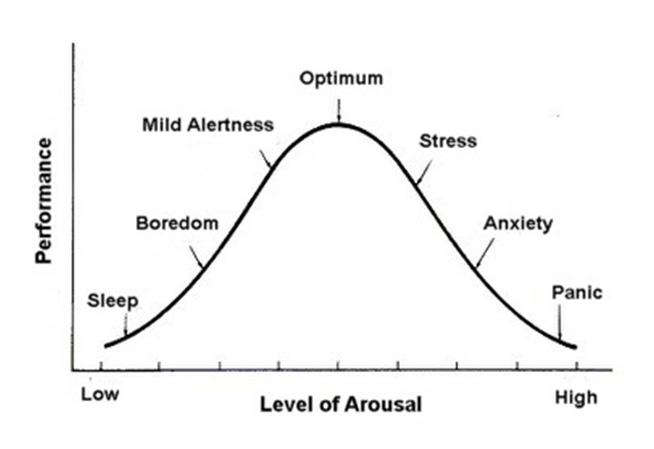
Let’s start with “next event”. As we get more stressed or anxious our performance decreases so we can start by narrowing that right down. We need a little stress to perform but once we tip over the top of that curve we need to bring our expectations of our performance back down to a level we can handle.
In that case, keep it simple. Only think about the next event. For example – keep flying, and get safe. That’s it. Just do that. It is something you can do and have done many times before. Now, breathe in, breathe out, and repeat as necessary. Now decide on your next event again. Maybe its go around for another approach or circuit.
Next event + 1. Once you start to get back on top of that performance curve again then start thinking not only of your next event but also the one after that. If you can, go for the one after that as well. Then you can start thinking about the events in ‘chunks’ i.e. instead of ‘fly the aeroplane’ you can think ‘fly the aeroplane back into the hold’. Once you can cope with that then you just keep looking further and further out and even start making the chunks larger then break them down when they are in front of you. For example, you can think you are going to descend to the holding pattern, hold, then conduct the approach. Then just start with the first chunk – descent – calculate when you will need it, decide on a configuration, calculate how long it will take, decide if you need clearance etc. Then once your descent is in hand go and start breaking down the next chunk – holding – decide on sector entry, decide on configuration etc.
That gives you some basics into “going around” both mentally and physically so now let’s take a step back even further and look into prevention. Firstly, and the main reason for this article, is for you to be aware of how your level of arousal/stress impacts your performance. Once you keep that in mind you will be more conscious of where you are on the curve at any moment (even if you have to make yourself think about it).
Once you are heading toward the right of that curve immediately intervene to bring the levels of stress back down again.
You can delay things – do an orbit or holding pattern, divert a bit to give yourself a few extra miles to think about descent. You can palm off some workload to someone else – ask ATC for a vector to delay you, ask a passenger/copilot to help lookout or check figures. Use a checklist or two – ensure everything in the previous checklist has been completed and that you are at the right stage of the current checklist (this will give you back some confidence that you are doing the right thing too).
You can also minimise your workload by using standardised procedures such as stabilised approaches. Recognise how human factors such as fatigue will play a part and plan accordingly. All of these are worth discussing but will take too much time here so will be the subject of separate articles.
In essence,make that go-around work for you – be it in life or a flight test. Pick yourself up, breathe in (and out, more than once) and relax. Are you safe? If not, make it so. Don’t worry about what comes after that until you are safe and have started to bring your stress levels back down. Don’t let the added stress of historical decisions degrade your performance now.
Adam Starr is an instructor and examiner who has been teaching in adult education since the 1980s. He specialises in adult education, flight instruction and testing and particularly in instrument flight in technologically advanced aircraft. He has over 1500 hours of instrument instruction and over 2500 hours instructing in Cirrus aircraft. Adam was Australia’s first Cirrus factory certified Platinum CSIP and has been training within the Cirrus factory training network for over 10 years. You can contact him at or on 0412469247.