

Adam is a Grade 1 Flight Instructor and Flight Examiner based at Archerfield. He is a Cirrus Standardised Instructor Pilot and IFR and glass cockpit specialist.
Testitis
Anxiety. Dread. Fear of Failure. This is not a gender specific complaint (regardless of however many genders there are nowadays). It occurs at test time and can be quite crippling just when you need to perform to a standard whilst being judged. It is a complaint that affects pilots, due to the nature of their profession (if you make mistakes, people may possibly die) and can also be found in other fieldswith potentially catastrophic consequences such as Air Traffic Control and medicine. I have worked, trained, taught and examined in allthese fields and there are definite similarities.
Unlike those other fields however, pilots can’t stop, handover to someone else, step back to take a breath or anything of the like (at least not for very long) as we are directly involved in the ongoing safe operation of our aircraft and the lives on board. Those lives also include our own which is different to the other fields where, if they stuff up it is usually someone else who may be at risk of injury or death. We are well aware that if we stuff up not only may others die but also ourselves. That just adds to the subconscious, self-induced stress of being a pilot.
Another interesting trait of the above-mentioned fields is that they attract a certain personality type. As a cohort we all want to succeed and we all want to be the best at what we do (just ask any pilot how good they are….!). This, in turn, adds even more self-induced stress to our operation. All of this happens any time we fly, before we even contemplate being tested! At test time all of the above stresses and concerns come into play as well as the added stress of flying with a stranger (often the case for a testing scenario) who is there to assess you, someone who may fail you and stop you flying, someone who will assess and make judgement about something you are so passionate/dedicated/professional about and someone who can absolutely demolish your ego and/or confidence.
I have seen examiners absolutely ‘carpet bomb’ the confidence of applicants to the point of, literally, no return. This is not the way it should be. Examiners who are unreasonable need to be pulled into line but to do that you need evidence of them actually being unfair rather than just having a different view of your capabilities. Applicants, however, should also be more prepared for tests. The thrust of this article is to help you understand better what an examiner should be expecting from a pilot being tested, while also letting you in on the standards that examiners should abide by.
How do I know what’s expected of me?
The first step to knowing what your examiner expects of you in a testis to understand the various competencies you will be tested on how they are officially regulated. I highly recommend that you become familiar with the CASA Part 61 Manual Of Standards (MOS) for flight crew licensing. It can be downloaded here:https://www.legislation.gov.au/Details/F2018C00657
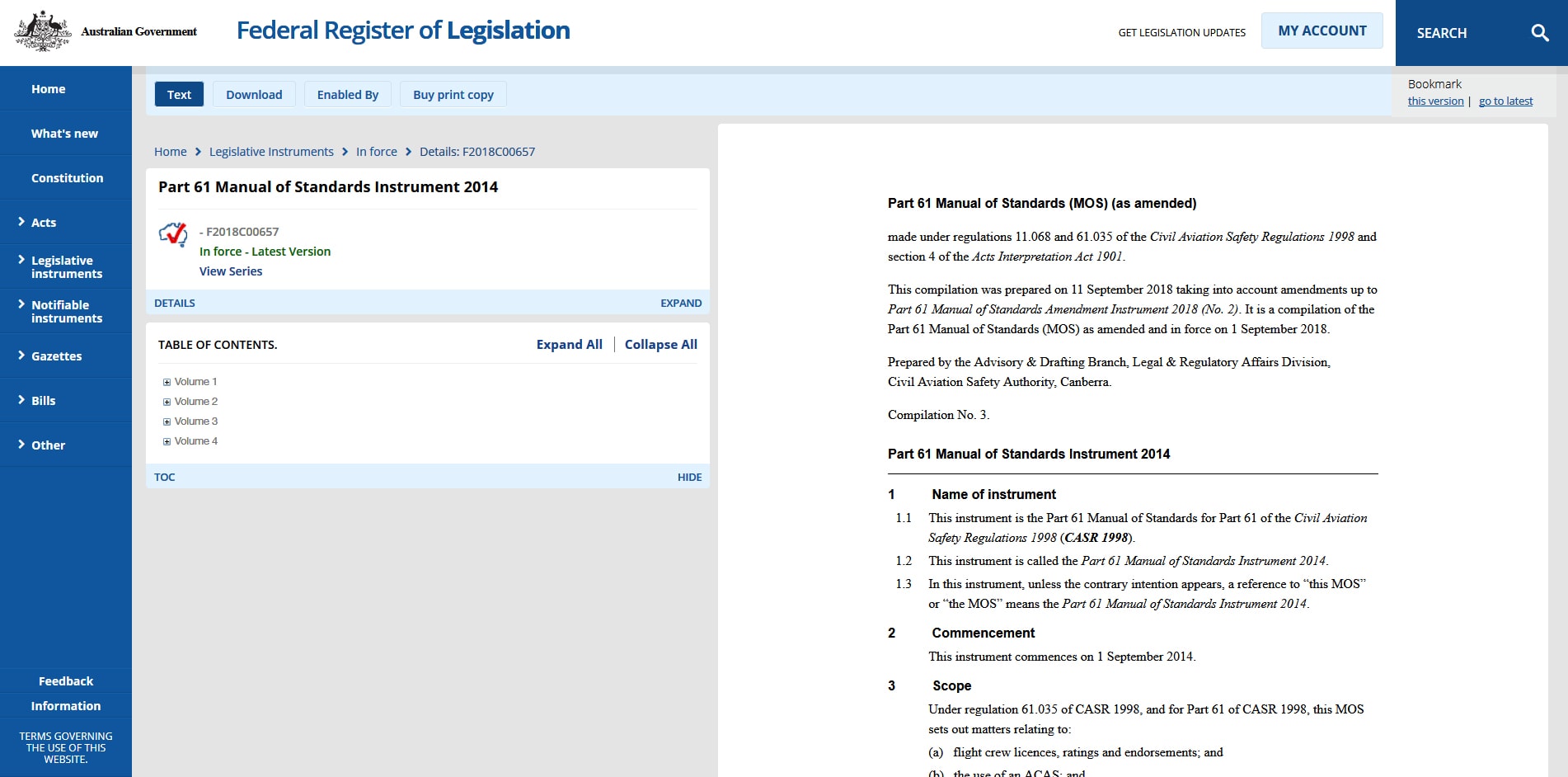
It can be a little difficult to digest as one massive document so why don’t you just download it and break it up into its parts/schedules. An introduction that breaks Part 61 down for you is provided at: https://www.casa.gov.au/standard-page/part-61-manual-standards
Basically, there is an introduction and some abbreviations and then the schedules:
- Schedule 1 = Directory of units
- Schedule 2 = Flight competency standards
- Schedule 5 = Flight Test standards
- Schedule 6 = Proficiency Check standards
- Schedule 7 = Flight Review standards
- Schedule 8 = Tolerances
Know your required competencies
You need to find what is actually required of you and therefore what you will be tested on. A lot of the anxiety builds because there is not a clear picture of the requirements. Don’t rely on hearsay – go to the source and know exactly what you will need to do. This holds true regardless if its RPL, PPL, IPC, ATPL – whatever. These are all in the MOS sections above so lets break it down.
The Directory of Units will tell you exactly which units are required for each qualification. To make it easy, lets just use the example of an Instrument Rating test. Firstly we need to go to Schedule 1 to define which units we need, and we go to the Instrument Rating section. Here we see that the Knowledge Standards needed are IREX and GNSS. Then below that (taking the example of a single engine aeroplane) we see that the Practical Flight Standards needed are NTS1, NTS2, IFF, IFL, CIR, NVR1, NVR2, and IAP2. Great – we have a list of topics to study!
Now we need to know what is included in those topics and that means using the other MOS Schedules. In this case we will need Schedule 2 (for flight competencies), Schedule 3 (for Theory Knowledge), Schedule 5 (for the actual test standards) and Schedule 8 (for the tolerances we must perform within). Go to Schedule 2 and 3 first and look up all the codes for all the topics you need (e.g. IREX, GNSS, NTS1, NTS2 … and so on, as seen above) and I would even suggest printing them out. Then read through them and tick off each item within them that you are confident with. Anything you are not confident with then just go and study, practise or grab and instructor to help you. This is basically the syllabus for your test. Once you are happy that you can answer/perform all parts of all of those topics then it is time to look at the test.
The test will reference MOS Schedule 5 and Schedule 8. Have a read of the parts for your test and you will see what the examiner must abide by. For a bit more detail also find the CASA test (just Google it – e.g. CASA Instrument Rating test form) and the Flight Examiner Handbook ()(again, just google CAS flight examiner handbook). With a combination of all of this knowledge you should know exactly what is going to happen and what your required competencies are. Finally, Schedule 8 will tell you the tolerances you have to perform within.
So how do I prepare for a test?
Know your own competency
Objectively and realistically. Every now and then go to the MOS and see what you haven’t done for a while and go and practise it. If you want to keep on top of things make a list of required competencies and tick them off after a flight. That way you can see things that you may not have done for a while. Maybe you have done RNAV approach after RNAV approach but haven’t done a hold or a VOR approach in a while. Maybe you haven’t done limited panel or unusual attitudes since your last IPC. Get someone else to provide an opinion (realistically and objectively). Find a friend/instructor/safety-pilot and go for a practice. Take charge of the mission – know which competencies you want to practise and go and do so.
Know your allowed tolerances
Whenever you fly, judge yourself against the tolerances of Schedule 8. Be realistic in this. If you are allowed +/- 100’ then making a pretty sine-wave while you bounce between the + and – limits may be in tolerance but may show that you are performance chasing not attitude flying. Try taking a friend/instructor to judge for you. Ask them to be harsh. Don’t accept “good enough” – the vast majority of pilots I know do not fall into this category and some can be too self-critical. Find a balance where you may be able to say “that was within tolerance but maybe I could do a bit better with some more practice”.
Take responsibility for your own training
As alluded to above, know what competencies you need to have achieved and revise that list periodically. If some things haven’t been practised for a while, then take a list of those and go have a fun flight with an instructor. Even use the list in your own flying, add something in to your next flight instead of just going A-B. It may only cost you a few minutes flight time as opposed to doing a whole training flight. Remember to be safe! Don’t get passengers to simulate engine failures or things of the like – take an instructor for that sort of thing (turn up with a list of competencies you need and they will be happy they don’t have to plan your lesson!).
Know how the day will progress
Have a look at the FEH. Download it from the CASA website and find the test page that applies to you. It will tell you exactly what to expect on the day. Nobody likes the unexpected. Many people have complained about how harsh or unrealistic an examiner is. If you find you are being harshly treated and it is outside the scope of the FEH/MOS then say something. Don’t just sit there with the blood pressure on a rapid rise, that won’t help your performance at all. The examiner may not realise that what they see as an informal discussion they are having with you is being seen as pass/fail testing.
Work a 90 day cycle
Every 90 days critically evaluate what you have done, where you were to standard and where you were not. Keep on to of it every 90 days and nothing will be a surprise. Not only that, you will be able to keep competent but you will also keep current.
Relax
Seriously! What is going to happen if you fail? By test stage you should be fairly confident that you can getfrom takeoff to landing alive. You should know what you can do well and what you may just need to snag on test day. Don’t use “I have done that better” to judge yourself, use “that was still within tolerance”. If you do perform out of tolerance, so what? Come back and do it again another day. No one is going to take your birthdays away from you if you can’t perform a perfect steep turn.
GrabTestitis by the MOS!
Own it and know how the test will turn out before you even turn up. If you use the informationabove there should be no surprises with either what is going to happen nor your level of competency. The test day should just be a demonstration of what you know you can already do with someone you may even get along with and/or learn something extra from for free.